
Posted On: 14 September, 2026
What if a grotto could tell a story?
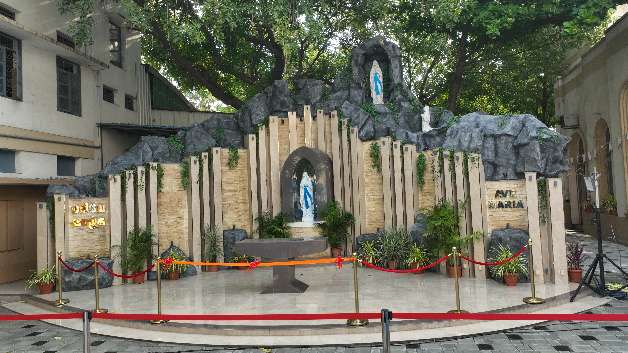
At Our Lady of Lourdes Shrine, Perambur, Chennai, the newly built grotto seeks to do precisely that. Called “The Mantle of Love,” the grotto is a contemporary reinterpretation of the traditional devotional grotto. It retains the familiar presence of rock, Mary, and prayer, while transforming them into a carefully conceived architectural experience.
The idea began with a simple question: How can a grotto become more than a rock formation with a statue? The answer is expressed through architecture, movement, symbolism, materials, and light.
The grotto is conceived as a small pilgrimage journey. Visitors enter and follow a pathway around the grotto, encounter the rugged rock formation, pause before a towering, curved structure, approach Mary, and finally arrive at the altar. The journey carries a symbolic meaning: from darkness to light, from burden to refuge, and from suffering to hope.
The Rock: The Burdens We Carry
The dark, rugged rock remains an important element of the grotto, but it carries a deeper meaning. It represents the “rocks” of human life—the burdens, fears, grief, disappointments, and struggles that people carry in their hearts.
Yet the rocks are placed behind the principal architectural structure. They become a backdrop to the human story: suffering is real, but it does not have the final word.
The Mantle: Mary’s Protection
The dominant architectural feature is a large curved enclosure. Its sweeping form evokes a mantle spread protectively around those who seek shelter.
The mantle thus becomes a symbol of Mary’s maternal care and protection. The devotee is not merely invited to look at Mary from a distance but can approach her, touch her, and pray.
Twenty-Four Pillars: The Church Gathered Around Mary
The vertical elements dominating the sacred space serve both an architectural and symbolic purpose. They create rhythm, height, depth, and a sense of monumentality. Symbolically, the 24 elements (pillars) represent the Twelve Apostles and the Twelve Marian stars.
The design deliberately avoids elaborate ornamentation. Instead, religious meaning is expressed through simple architectural forms—a distinctive feature of the project: traditional meaning expressed through contemporary architecture.
The Crown and the Trinity
Above Mary’s niche are three simple architectural elements. Together, they suggest a crown, recalling Mary’s queenship, while also evoking the Holy Trinity—Father, Son, and Holy Spirit.
From
From Lourdes to Perambur
The grotto’s inspiration ultimately reaches back to the Massabielle Grotto at Lourdes, where Mary appeared to Bernadette Soubirous in 1858. The Perambur grotto, however, is not intended to be a replica of Lourdes. Rather, it translates the spiritual experience associated with Lourdes—prayer, pilgrimage, consolation, healing, trust, and welcome—into a contemporary architectural setting.
This connection is especially meaningful because the Perambur shrine has a long association with Lourdes. The church was founded in 1879, just 21 years after the apparitions at Lourdes, and is believed to be the second oldest church dedicated to Our Lady of Lourdes in India and Asia. Ever since, it has grown into an important centre of Marian devotion and pilgrimage.
From Darkness to Light
Light completes the story of the grotto. Warm illumination gradually transforms the atmosphere, becoming a symbol of hope emerging from darkness. Thus, the grotto is not simply something to look at; it is something to experience.
The visitor enters carrying the metaphorical weight of life’s “rocks,” moves beneath Mary’s protective mantle, encounters her maternal presence, places those burdens before God in prayer, and moves towards light.
The altar provides a setting for Masses and communal celebrations, while the surrounding space enables individuals to pause, sit, and pray.
The grotto was designed by Laura Noel, a student of architecture and parishioner of Our Lady of Lourdes, Perambur. Its foundation stone was blessed by Fr. Fabio Attard, SDB, Rector Major of the Salesians of Don Bosco, on 14 February 2026. The completed grotto was blessed and inaugurated by Fr. Don Bosco Lourdusamy, SDB, Salesian Provincial, on 5 September 2026.
The Mantle of Love now stands as a new landmark of Marian devotion at Perambur—where architecture, faith, and symbolism come together to offer pilgrims not merely a place to pray, but a place to lay down their burdens and experience peace.